The Challenge
When customers need help, they want answers quickly.
Vhi recognised an opportunity to improve how members find support online and partnered with UX Tree to explore the problem from a user experience perspective.
As part of the project, UX designer Florence McLoughlin worked closely with mentor David Jackson, Founder of Friday Agency, to investigate how customers navigated Vhi’s Help and Support experience and identify opportunities to make self service easier and more effective.
The goal was simple: help more customers find the information they need without frustration, hesitation, or unnecessary contact with support teams.
What We Found
The research quickly revealed that finding support was harder than it needed to be.
Florence conducted user interviews, surveys, usability testing, competitor analysis, and information architecture research with participants ranging from their twenties to seventies. The findings challenged some initial assumptions.
Users could technically reach information within a few clicks, but that wasn’t the real problem.
The real issue was confidence.
Many users struggled to locate the Help and Support area in the first place. Others hesitated because the page felt overwhelming, difficult to scan, and packed with competing information. Dense content, unclear categories, and weak visual hierarchy created friction throughout the experience.
In usability testing:
• 5 out of 6 participants struggled to find the Help and Support page
• 3 out of 6 users abandoned the task completely
• Average time to find information was 1 minute and 41 seconds
For customers looking for a quick answer, those extra seconds created frustration. For Vhi, they created unnecessary demand on support channels.
Turning Research Into Action
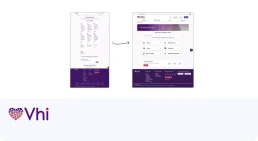
Working through a structured UX process, Florence redesigned the experience around one key principle: helping users find answers with less effort.
The new design introduced:
• A clearer Help Centre entry point within navigation
• Smarter search with autocomplete suggestions
• Simpler content organisation
• Fewer support categories
• Improved visual hierarchy
• More accessible and predictable navigation patterns
Rather than adding more content, the project focused on removing complexity.
The number of support categories was reduced from 11 to 6, secondary links were removed, and information was reorganised around how users naturally look for answers.
The Results
The redesigned experience was tested with users to validate whether the changes actually worked.
The results were significant.
After testing the prototype:
• 8 out of 8 users successfully found the Help and Support section
• 8 out of 8 users found the information they needed within one or two clicks
• 8 out of 8 users completed their task in under 45 seconds
Users consistently described the experience as clearer, easier to navigate, and less overwhelming.
While the project was delivered as part of a UX Tree mentorship programme, the outcome reflects the same approach we bring to every client challenge: understand real user behaviour, identify friction, and validate solutions through research and testing.
Why Companies Work With UX Tree
Many organisations know they have customer experience problems. The challenge is understanding where those problems exist and what to do next.
UX Tree helps organisations uncover those opportunities through research driven design, fresh external perspectives, and hands on collaboration with experienced industry mentors.
In this project, Vhi gained actionable insights into customer behaviour, validated design recommendations, and a clearer understanding of how to reduce friction in a critical support journey.
For startups, scaleups, and enterprise organisations alike, that’s often the difference between building features people use and building features people ignore.
Sometimes the biggest improvements don’t come from adding something new.
They come from making it easier for customers to help themselves.
Our team combines experienced UX mentors, emerging talent, and proven UX methodologies to uncover opportunities, validate solutions, and deliver actionable recommendations you can take forward with confidence.
If you have a product, service, or customer experience challenge you’d like to explore, we’d love to hear from you.
Get in touch to discuss your next project and discover how UX Tree can help you create better experiences for your customers.